Service Dog Tasks and the Public Access Test, Explained
This page explains the law in general terms. It is not legal advice. For a specific situation, contact the agency listed on this site or an attorney.
People often ask what tasks a service dog can do, and whether a dog has to pass a public access test to be allowed in stores and restaurants. The two questions are linked, but the answers come from different places. Tasks are part of the legal definition of a service dog. The public access test is a training benchmark.
This guide covers both for handlers in Wisconsin. It explains what counts as a task, how to teach one, and how to use a public access test to check your progress. It is general information, not legal advice.
What counts as a service dog task
ADA.gov says a service animal is a dog that has been individually trained to do work or perform tasks for an individual with a disability. The key idea is that the work is directly related to the person's disability.
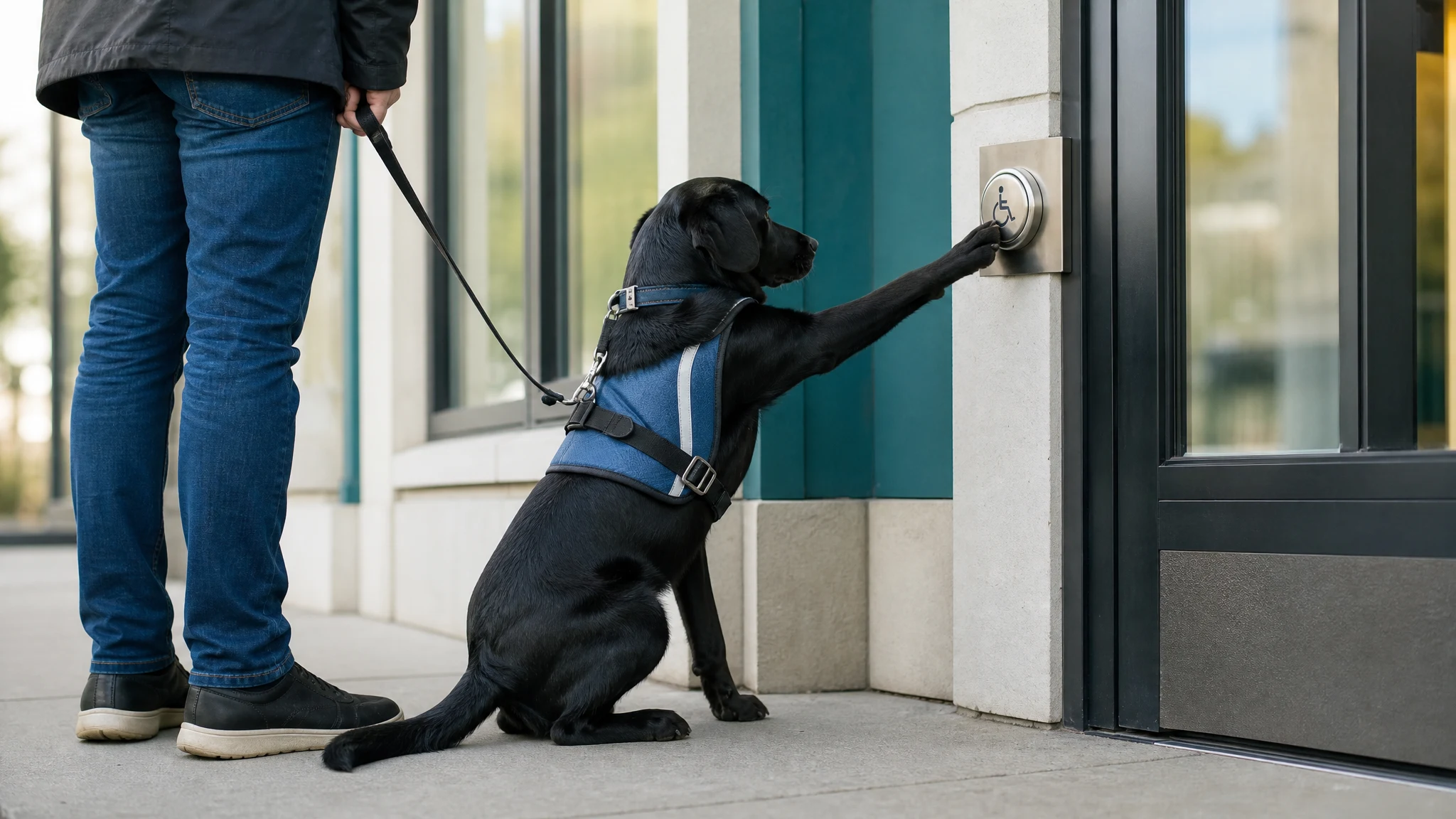
A task is something the dog does on purpose, on cue or in response to a specific trigger, that helps with a limitation caused by the disability. It can be a physical action, such as opening a door. It can also be an alert or an interruption, such as nudging a handler out of a harmful pattern of behavior.
Examples of tasks by disability
These are common examples of what a service dog can do. Each dog is trained for the needs of one handler, so no list is complete.
- Mobility disabilities: retrieving dropped items, opening doors, pulling a wheelchair, or bracing so a handler can stand.
- Vision loss: guiding around obstacles and stopping at curbs and stairs.
- Hearing loss: alerting to a doorbell, a smoke alarm, a knock, or a person approaching.
- Diabetes or seizure disorders: alerting to a change before it becomes an emergency, or fetching medication or help.
- Psychiatric disabilities, including PTSD: interrupting repetitive or self-harming behavior, turning on lights, or creating space in a crowd on cue.
- Autism: interrupting repetitive behaviors or keeping a child from bolting, depending on how the dog is trained.
Wisconsin's definition in Wis. Stat. 106.52(1)(fm) lists similar examples. It names guiding a person with impaired vision, alerting to intruders or sound, minimal protection or rescue work, pulling a wheelchair, and fetching dropped items. The statute is broader than the ADA because it covers animals other than dogs. It also covers animals that are still being trained.
Why comfort alone is not a task
Under the ADA, emotional support, therapy and comfort animals are not service animals. A dog that calms people by being near them is not performing a trained task, even if the comfort is real and valuable.
A psychiatric service dog is different. It can be trained to do something specific, such as interrupting a panic response or waking a handler from a nightmare. The test is whether the dog does a trained action that helps with the disability, not whether the dog makes the handler feel better.
Wisconsin housing law treats emotional support animals separately. Wis. Stat. 106.50(2r) addresses disability-related need for an emotional support animal in housing, and that is a different question from public access.
What you need before you start
- A dog with a steady temperament, good health and the physical ability to do the planned tasks. Ask your own veterinarian about health and fitness for the work.
- Small, soft, high-value treats and the dog's regular meals for rewards.
- A well-fitted flat collar or harness and a standard leash of about six feet. Do not use shock, prong or choke collars.
- A clicker or a marker word such as "yes", if you want to mark exact moments of success.
- A training log to record each session, the task, the setting and the result.
- A written list of your disability-related needs, so each task you teach has a clear purpose.
- Helpers and practice locations that increase in difficulty over time.
Step-by-step: teaching a task and preparing for the public access test
Step 1: Name the need, then choose the task
Start with the limitation, not the trick. Write down what the disability makes difficult, then choose a behavior that directly reduces that difficulty.
"Pick up my dropped phone" is a task. "Look cute in a vest" is not. If you cannot say how the behavior relates to the disability, it is probably not a task under the ADA definition.
Step 2: Build foundation skills first
Before any task, teach the basics that keep the dog safe and settled in public. These are loose-leash walking, sit, down, stay, come when called, a settle on a mat, and calm behavior around food and other dogs.
Keep sessions short, usually a few minutes, and end while the dog is still succeeding. The American Veterinary Society of Animal Behavior (AVSAB) supports reward-based training. That means you reward what you want and avoid methods that rely on fear or pain.
Step 3: Teach the task in small pieces
Break the task into steps and reward each one. For a retrieve, you might reward looking at an item, then touching it with the nose, then mouthing it, then carrying it, then placing it in your hand.
Add the cue only after the dog reliably does the behavior. For an alert task, you pair the dog's alert with the trigger and reward it every time at first. A trainer experienced in medical alert work can help with this, because the trigger often needs careful handling.
Step 4: Practice in real situations
A task taught only in the living room often falls apart in a store. Move gradually: a quiet room, then the yard, then a hallway, then a quiet shop, then busier places.
Lower your expectations a little in each new setting and raise your reward rate. If the dog struggles, go back one step instead of pushing through.
Step 5: Add public manners
Work on ignoring food on the floor, staying out of the aisle, settling under a table, and not greeting strangers or other dogs. A service dog that is working should stay focused on the handler.
Practice in places you actually go, such as a grocery store, a pharmacy, a clinic waiting room and a restaurant. Always ask first where a business has its own rules about trainers.
Step 6: Use the public access test as a benchmark
Assistance Dogs International (ADI) publishes a public access test that its member programs use. It checks whether a dog and handler team can behave well in public settings. It is a way to measure training progress.
It is not a requirement under the ADA, and it is not a license. ADA.gov describes no test, registry or certificate that a dog must hold. Check ADI directly for the current version of the test, because standards can be updated.
A practical way to use it is to ask a trusted friend or a trainer to watch a practice outing and score it honestly. Note the weak spots, such as distraction around food or restlessness in lines, and train those skills before the next outing.
Step 7: Keep records and review often
Write down what the dog can do, how reliably, and in which settings. Repeat the benchmark every few months. Dogs can slip as they mature or when routines change, and a log helps you notice early.
Wisconsin law, access and what staff may ask
Wis. Stat. 106.52(3)(am) says it is discrimination to deny a person with a disability, or a service animal trainer, entrance to or full and equal enjoyment of a public place of accommodation or amusement because they are accompanied by a service animal. It is also discrimination to charge a higher price, including a deposit or surcharge. A business may exclude a service animal if accommodating it would result in a fundamental alteration.
The statute also says a person with a disability may not be required to produce documentation of the disability or a certification that the animal is trained. That fits with the ADA, where there is no certificate that proves a dog is a service dog.
ADA.gov says that when it is not obvious the dog is a service animal, staff may ask only two questions. Is the dog a service animal required because of a disability? What work or task has the dog been trained to perform? Knowing your answer to the second question in one clear sentence is one of the most useful skills a handler can practice.
If your dog is still in training
Wisconsin's definition covers animals being trained, and the access rule extends to a service animal trainer. Under Wis. Stat. 106.52(3)(am), the protections apply to a trainer only if the animal is wearing a harness, or a leash and special cape. A trainer may be asked to produce a certification or credential issued by a school for training service animals showing the animal is being trained as a service animal.
The statute text does not state an age requirement. Check with the Wisconsin Department of Workforce Development, Equal Rights Division, or an attorney if you are unsure whether you qualify as a trainer.
For more on rights and access, see our guide to service dogs in Wisconsin, including training, access rights and where they are allowed.
Tips and common mistakes to avoid
- Mistaking comfort for a task. If the only thing the dog does is provide emotional comfort, it does not meet the ADA definition.
- Buying a vest, ID or online "registration" as proof. No official registry or required certification exists under the ADA. An online registration is not legal proof of anything.
- Skipping the foundation. Advanced tasks fail when basic focus and calm behavior are weak.
- Training for too long. Tired dogs make mistakes, and mistakes in public are hard to undo.
- Moving too fast into busy places. Increase difficulty in small steps and return to an easier setting after a rough day.
- Using harsh methods. Shock, prong or choke collars, alpha rolls, scruffing and dominance methods are not recommended and can damage trust and reliability.
- Treating the test as a pass or fail verdict. It is a checklist for training, not a legal gate.
- Ignoring the dog's welfare. A dog that is stressed, fearful or unwell may not be suited to public work. That is not a failure on your part, and it is better to know early.
Finding help in Wisconsin
Some Wisconsin nonprofits place or support service dogs. Custom Canines Service Dog Academy in Madison lists support for owner-trainers, and it also serves veterans and first responders. Patriot K9s of Wisconsin in Wausau works with veterans on psychiatric service dog teams. Dogs2DogTags in Plymouth works with veterans as well.
Costs, eligibility and waitlists change, so contact each organization directly for current details. Each program has its own application process.
What to expect
With steady, reward-based practice, many handlers find that a dog can learn a well-chosen task over several weeks or months. Reliability in public places usually takes longer, and results vary with the dog's temperament, health, age and the handler's consistency.
A practice run through a public access benchmark may help you see which skills are solid and which need work. It cannot predict how a dog will behave on any given day, and it does not replace ongoing training.
Misrepresentation and complaints
Wisconsin has no enacted penalty for falsely claiming a service animal in public. A 2025 bill, AB 366, would have created fines, and Gov. Evers vetoed it on December 5, 2025. Separately, Wis. Stat. 951.097 addresses harassment of service dogs, with penalties in 951.18(2s).
If you believe you were wrongly denied access, you can contact the Wisconsin Department of Workforce Development, Equal Rights Division. Check with the division about which complaints it accepts and how to file.
Sources
- ADA.gov, Frequently Asked Questions about Service Animals and the ADA
- Animal Legal and Historical Center (Michigan State University), Wisconsin assistance animal laws, including Wis. Stat. 106.52, 106.50(2r) and 951.097
- Wisconsin Department of Workforce Development, Equal Rights Division
- Custom Canines Service Dog Academy
- Patriot K9s of Wisconsin
- Dogs2DogTags