Service Dogs in Wisconsin: Training, Access Rights and Where to Start
This page explains the law in general terms. It is not legal advice. For a specific situation, contact the agency listed on this site or an attorney.
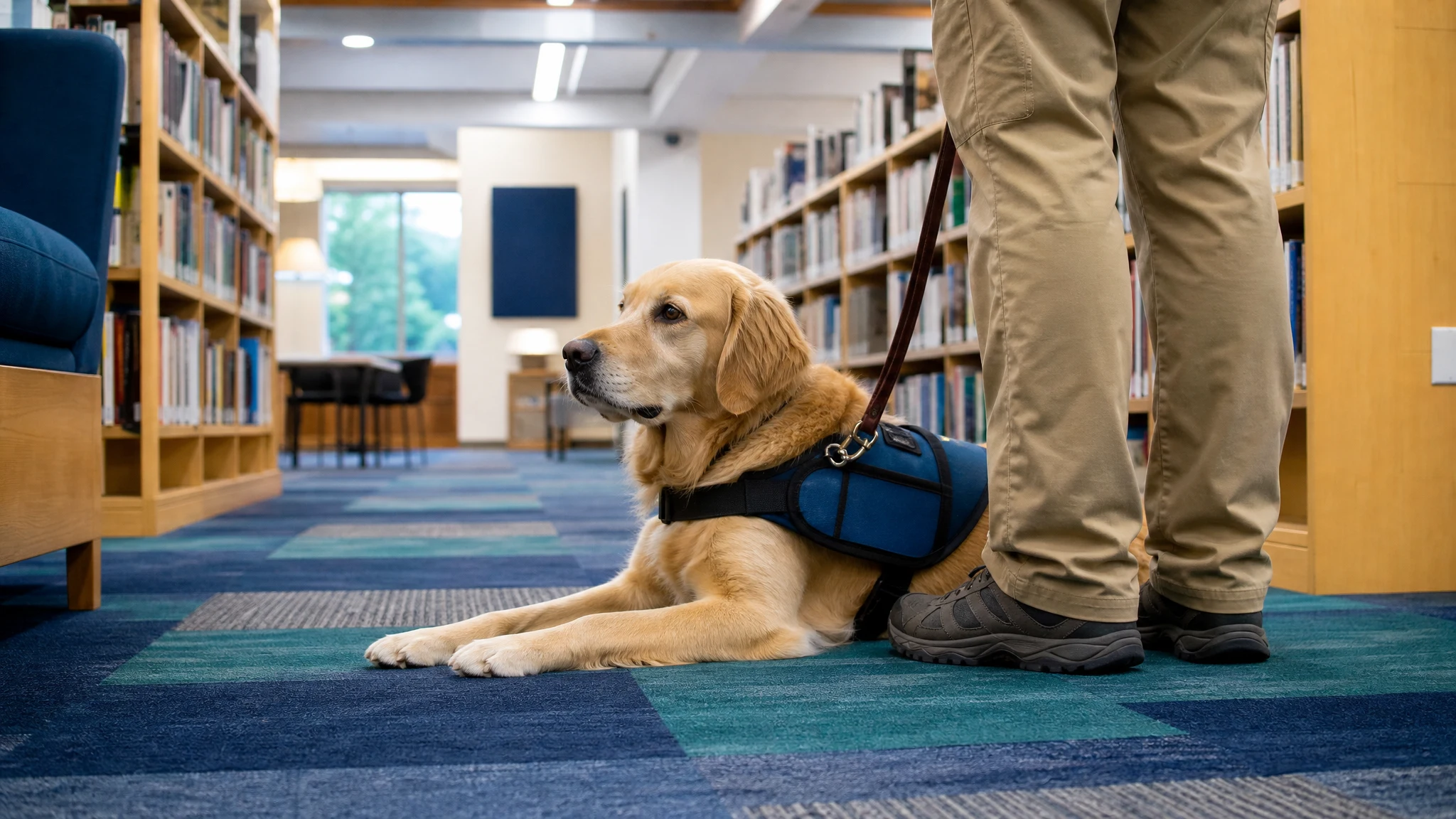
A service dog is a working dog with a specific job. In Wisconsin, two layers of law shape what that means: the federal Americans with Disabilities Act (ADA) and the state's own statutes. They overlap, but they are not identical.
This guide covers who qualifies, where a service dog may go, the two main routes to getting one, what training involves, and the Wisconsin organizations worth contacting. It states the law in plain English. It is not legal advice, and it points you to the right agency when you need one.
Key takeaways
- Under the ADA, a service animal is a dog individually trained to do work or perform tasks for a person with a disability (ADA.gov).
- Wisconsin's definition in Wis. Stat. 106.52(1)(fm) is broader. It covers animals other than dogs, and animals being trained.
- There is no official service dog registry or required certification under the ADA. Wisconsin law says a person with a disability may not be required to produce documentation of the disability or a certification that the animal is trained.
- There are two routes: a dog placed by a program, or a dog trained by its owner, sometimes with a trainer's help.
- Emotional support, therapy and comfort animals are not service animals under the ADA.
- Costs, waitlists and eligibility vary a lot by organization. Always confirm with the program itself.
Contents
- What counts as a service dog in Wisconsin
- Access rights: where a service dog may go
- Who qualifies for a service dog
- The two routes: program-trained or owner-trained
- What service dog training involves
- Costs and waitlists
- Wisconsin organizations to know
- Where to start, and what to do if something goes wrong
What counts as a service dog in Wisconsin
The words "service dog" get used loosely. The law uses them precisely, and the details matter when you are at a store door or talking to a landlord.
The federal definition
ADA.gov, in its Frequently Asked Questions about Service Animals and the ADA, says a service animal is a dog that has been individually trained to do work or perform tasks for an individual with a disability.
Two parts of that sentence do most of the work. The dog is individually trained, and it performs work or tasks tied to the person's disability. Being friendly, calm or comforting is not enough on its own.
Wisconsin's definition
Wisconsin Statutes section 106.52(1)(fm) defines a service animal as a guide dog, signal dog, or other animal individually trained or being trained to do work or perform tasks for the benefit of a person with a disability. The examples the statute lists include guiding a person with impaired vision, alerting to intruders or sound, minimal protection or rescue work, pulling a wheelchair, and fetching dropped items. The text is reproduced by the Animal Legal and Historical Center at Michigan State University.
Compare that with the ADA wording. Wisconsin's definition is not limited to dogs, and it includes animals that are still in training. That makes the state definition broader than the federal one.
What is not a service animal
Under the ADA, emotional support animals, therapy animals and comfort animals are not service animals. A dog that provides comfort by being present has not been trained to perform a task. A dog trained to interrupt a panic episode, retrieve medication, or alert to a medical event is doing a task.
This is a real distinction, not a ranking of how much a dog matters. Wisconsin also has a separate housing rule for emotional support animals, covered below.
Access rights: where a service dog may go
Access rights come from both federal and state law. Knowing what each says helps you stay calm and clear if a business questions your dog.
What staff may ask under the ADA
ADA.gov says that when it is not obvious the dog is a service animal, staff may ask only two questions:
- Is the dog a service animal required because of a disability?
- What work or task has the dog been trained to perform?
That is the full list on ADA.gov. The page does not describe any other required proof. Because there is no ADA registry, a certificate or ID card bought online is not legal proof of anything, and no one needs one to enter a public place.
Wisconsin public access
Wis. Stat. 106.52(3)(am)1, as reproduced by the Animal Legal and Historical Center, says it is discrimination to deny a person with a disability, or a service animal trainer, entrance to or full and equal enjoyment of a public place of accommodation or amusement because they are accompanied by a service animal.
The same provision says it is discrimination to charge them a higher price, including a deposit or surcharge. A place may exclude a service animal if accommodating it would result in a fundamental alteration. A person with a disability may not be required to produce documentation of the disability or a certification that the animal is trained.
Dogs in training
Wisconsin goes further than the ADA here. The 106.52(1)(fm) definition covers animals being trained, and 106.52(3)(am) extends access protections to a service animal trainer.
There are conditions. According to the statute text, the protections apply to a trainer only if the animal is wearing a harness, or a leash and special cape. A trainer may be required to produce a certification or credential issued by a school for training service animals, showing the animal is being trained as a service animal.
The statute text does not state an age requirement for the dog. If you are an owner-trainer wondering how these conditions apply to you, check with the Wisconsin Department of Workforce Development, Equal Rights Division before relying on trainer access.
Housing
The Wisconsin Fair Housing Law, Wis. Stat. 106.50(2r), makes it discrimination to refuse to rent or sell housing to a person with a disability who has a disability-related need for an emotional support animal. A housing provider may request reliable documentation from a licensed health professional.
The same provision penalizes misrepresentation. An individual who intentionally misrepresents a disability or the need for an emotional support animal to obtain housing forfeits not less than $500 (106.50(2r)(br)5). A licensed health professional who misrepresents a patient's disability or need forfeits not less than $500 (106.50(2r)(br)6).
The statute text on service animals in housing was not independently confirmed for this guide. If you have a service dog and a housing dispute, check with the agency listed in the last section.
Employment
This guide does not state a Wisconsin rule for service dogs in the workplace. If you need your dog at work, ask the Equal Rights Division what applies to your situation.
Who qualifies for a service dog
The ADA does not hand out a list of approved conditions. The test is whether a person has a disability and whether the dog is individually trained to do work or perform tasks for that person.
Wisconsin's examples include guiding for impaired vision, alerting to sound, pulling a wheelchair and fetching dropped items. Organizations in Wisconsin also list work for conditions such as post-traumatic stress, traumatic brain injury, autism, hearing loss, mobility limits, seizures and diabetes. Each program sets its own eligibility rules, so a person who qualifies under the law may still need to meet a program's separate requirements.
Some programs focus on a particular group. Patriot K9s of Wisconsin works with veterans. DogsInVests lists autism and children as its focus. Can Do Canines lists mobility, hearing, diabetic alert, seizure and autism work. Look at who a program serves before you apply.
Do you need a doctor's letter or certificate?
For public access, no. Wis. Stat. 106.52(3)(am) says a person with a disability may not be required to produce documentation of the disability or a certification that the animal is trained. A program may still ask for medical information during its own application. That is the program's process, not a legal requirement for entering a store.
For housing involving emotional support animals, the Wisconsin Fair Housing Law lets a provider request reliable documentation from a licensed health professional. That rule is about emotional support animals in housing, not about public access for service dogs.
The two routes: program-trained or owner-trained
Most people reach a service dog in one of two ways. Neither is the single correct choice. The right one depends on your needs, your time, your budget and how much you want to be involved in training.
Route one: a dog placed by a program
A program breeds, selects or rescues dogs, trains them, and places them with a handler. Handlers usually go through application, matching and team training. Waitlists can be long, and some programs serve only specific groups, such as veterans or children with autism.
Advantages: trained staff handle selection and much of the early work, and the program may offer follow-up support. Trade-offs: waiting time, eligibility limits, and less control over the dog's background.
Route two: owner-trained
In an owner-trained route, you train your dog yourself, often with outside help from a trainer or a program that supports owner-trainers. The ADA does not require a professional trainer. The requirement is that the dog is individually trained to do work or perform tasks.
Advantages: more control over timing and tasks, and a dog you already know. Trade-offs: a large time commitment, the risk that a particular dog is not suited to the work, and the need to keep training consistent for years.
Custom Canines Service Dog Academy in Madison lists owner-trainer support among its services. If you are considering this route, ask what the support involves and how it is delivered.
How to choose
Ask yourself a few plain questions:
- Can I wait for a placement, or do I need to start now?
- Do I meet a program's eligibility rules?
- Do I have the time and energy to train a dog daily for a long period?
- What tasks do I need the dog to do, and who can help me teach them?
What service dog training involves
Service dog training has three broad parts. They build on each other, and a gap in one shows up in the others.
Foundation behavior and temperament
A service dog needs to be calm, social and steady around the things public life throws at it. That includes crowds, noise, strange floors, food on the ground and other animals. Not every dog has the temperament for this, which is one reason programs select dogs carefully.
Basic skills usually include walking politely on a leash, settling quietly, coming when called and ignoring distractions. These are the base layer that makes task work safe.
Task training
Tasks are the work that ties the dog to your disability. Wisconsin's statute lists guiding, alerting to sound or intruders, pulling a wheelchair and fetching dropped items as examples. Other tasks might include retrieving items, providing balance support, or interrupting a behavior pattern, depending on the handler's needs.
Under the ADA, this is what separates a service dog from a pet or comfort animal. Be ready to name the task when asked the second ADA question. A clear, simple answer works best.
Public access skills
Public access training teaches the dog to behave in stores, offices, clinics and transport. Staying under a table, not sniffing merchandise and ignoring food are typical goals. This stage often takes the longest because real settings are less predictable than a training room.
Humane, reward-based methods
Training methods should be humane and reward-based, in line with the position of the American Veterinary Society of Animal Behavior (AVSAB). Reward-based training uses food, play and praise to teach the dog what to do. Shock, prong and choke collars, alpha rolls, scruffing and dominance methods are not recommended. They can create fear and stress, which works against the steady temperament a service dog needs.
If you hire a trainer, ask what methods they use and how they would handle a mistake. A trainer who relies on punishment is a poor fit for this work.
Keeping skills sharp
Training does not end at placement or graduation. Handlers keep practicing tasks and public manners, and recheck them if the dog's behavior changes. A handler who stays consistent usually keeps a more reliable team.
Costs and waitlists
Costs vary widely, and this guide cannot give a single typical price. The programs listed below describe their costs in different ways, and some do not state them at all. Confirm any figure directly with the organization before you plan around it.
What Wisconsin programs say
| Organization | Location | What it says about cost or waiting |
|---|---|---|
| Patriot K9s of Wisconsin | Wausau | Says it educates and trains Psychiatric Service Dog Teams at no cost to qualified Veterans. Waitlist not stated. |
| Dogs2DogTags | Plymouth | Says there is no cost for a veteran to receive a service dog, emotional support animal or canine companion. Waitlist not stated. |
| Custom Canines Service Dog Academy | Madison | The Kenosha County ADRC listing says dogs are placed at no cost to the recipient, with a $75.00 non-refundable application fee, and a 3-5 year waiting list. The program's own website does not state a waitlist. |
| DogsInVests, Inc. | Palmyra | Cost and waitlist not stated. Contact the organization. |
| Can Do Canines | New Hope, Minnesota | Says it provides assistance dogs to people with disabilities free of charge. Waitlist not stated. |
| Got Your Six K9s | Not confirmed | A Wisconsin Veterinary Medical Foundation article says it costs a veteran $400 to enter the program. The article may be dated, so confirm the current figure. |
Reading these figures carefully
"No cost to the recipient" describes what the person receiving the dog pays. It does not mean the dog is cheap to produce, and programs often rely on donations and grants. Ongoing costs such as food, veterinary care and equipment usually fall to the handler, so ask each program what it covers.
The Custom Canines waiting period comes from a county listing rather than the program's own site, so treat it as a starting point and ask the academy for its current timeline.
The owner-trained route
No Wisconsin cost figures for owner-training were available for this guide. Expect costs for the dog, veterinary care, equipment and any trainer you hire. Ask trainers for written fee information before you commit.
Wisconsin organizations to know
These are the organizations named in the sources for this guide. Inclusion is not an endorsement, and we have not visited, tested or reviewed any of them. Check each program's website for current eligibility, fees and application steps.
Patriot K9s of Wisconsin (Wausau)
A nonprofit that provides service dogs and training for veterans affected by military-related post-traumatic stress, traumatic brain injury and military sexual trauma. It says its service is free to qualified Veterans. Website: patriotk9s.org.
Dogs2DogTags (Plymouth)
A nonprofit that pairs veterans who have PTSD or anxiety with trained rescue or donated dogs at no cost. A Wisconsin governor's office release says that since 2016 it has paired 38 veterans with dogs, including eight service dog teams. The same release says it received a $77,008 grant announced by the Wisconsin Department of Veterans Affairs to train and place service dogs with veterans. Website: dogs2dogtags.org.
Custom Canines Service Dog Academy (Madison)
A nonprofit serving military veterans and first responders living with disabilities. Its listed areas include guide, mobility and autism work, plus owner-trainer support. Its website directs applicants to an Apply Now link. Website: customcanines.org.
DogsInVests, Inc. (Palmyra)
A nonprofit that lists autism and children as its focus. Cost and waitlist details were not available. Website: dogsinvests.org.
Can Do Canines (New Hope, Minnesota)
An Assistance Dogs International accredited organization based in Minnesota that serves Wisconsin. Its materials mention a hearing dog placed in Mequon, Wisconsin. It lists mobility, hearing, diabetic alert, seizure and autism work. Website: candocanines.org.
Got Your Six K9s
A Wisconsin-based nonprofit that trains service dogs to help veterans cope with PTSD and other service-related injuries, founded by Jeremy Van Beek according to a Wisconsin Veterinary Medical Foundation article. The article may be dated, so confirm that the program is currently active and what it charges.
What this list does not cover
This guide did not confirm a complete list of Assistance Dogs International members in Wisconsin, or a specific Wisconsin Department of Veterans Affairs service dog program. Ask your veteran service officer or the programs above about additional options.
Where to start, and what to do if something goes wrong
A practical starting path
- Define the tasks you need. Write down what a dog would do for you, such as retrieving items, alerting to sound or providing balance support. This clarifies both program fit and training goals.
- Choose a route. Decide whether to apply to a program, train your own dog, or pursue both while you wait.
- Contact programs directly. Ask about eligibility, cost, waitlist, how long placement takes and what follow-up support exists. Ask the same questions of each.
- Plan the training approach. If you are an owner-trainer, find a trainer who uses reward-based methods in line with AVSAB.
- Learn your rights. Read the ADA.gov service animal FAQ and the Wisconsin statutes cited here.
- Skip registries. No official registry or certification is required under the ADA, and an online registration is not legal proof. Do not pay for one thinking it is needed.
Harassing a service dog is a crime in Wisconsin
Wisconsin has a dog-specific harassment statute, Wis. Stat. 951.097, with penalties in 951.18(2s), according to the Animal Legal and Historical Center. A knowing violation is a Class B misdemeanor for reckless interference and a Class A misdemeanor for intentional interference. Killing or taking a service dog is a felony.
In practice, this means other people should not pet, call to, feed or distract a working service dog. If someone does, you can ask them to stop.
False claims
Wisconsin has no enacted penalty for falsely claiming a service animal in public. In 2025, Assembly Bill 366 would have created fines of $200 and $500. According to FOX6 News, Governor Evers vetoed it on December 5, 2025. The separate $500 forfeiture for misrepresentation in housing, described above, is limited to emotional support animals in housing.
Legal penalties aside, a dog that is not trained or not under control can cause harm to people and to the reputation of genuine service dog teams.
Where to take a complaint
The Wisconsin Department of Workforce Development, Equal Rights Division is the state agency to ask about discrimination complaints. Its website confirms its work on employment matters. Whether it takes a particular public accommodation or housing complaint should be confirmed with the division directly. The ADA.gov service animal FAQ is the federal starting point for questions about the ADA.
If a business denies you entry, stay calm, state that the dog is a service animal required because of a disability, and name the task if asked. Write down the date, place and what was said. Then contact the agency for guidance. This guide is general information, not legal advice.
Final thoughts
Getting a service dog in Wisconsin takes planning, patience and clear information. Know the legal definition, be ready to name your dog's tasks, choose a humane training approach, and contact programs directly about cost and waitlists. Start with the sources below, then the organizations that match your needs.
Sources
- ADA.gov, Frequently Asked Questions about Service Animals and the ADA
- Animal Legal and Historical Center (Michigan State University), Wisconsin assistance animal laws: Wis. Stat. 106.52, 951.097, 951.18 and 106.50(2r)
- Wisconsin Department of Workforce Development, Equal Rights Division
- FOX6 News, Wisconsin fake service animal fine veto
- Patriot K9s of Wisconsin
- Dogs2DogTags
- State of Wisconsin release on Dogs2DogTags
- Custom Canines Service Dog Academy
- Kenosha County ADRC listing for Custom Canines
- DogsInVests, Inc.
- Can Do Canines
- Wisconsin Veterinary Medical Foundation article on Got Your Six K9s